By Ari Charlestein | Updated November 2026
An Amazing Race style corporate trip puts colleagues into small teams, sends them through a region on a hidden itinerary, and scores them on hands-on challenges along the way. Nobody sees the agenda in advance, which is precisely why it works: people cannot opt out of a plan they have not read. Competitours has run this as corporate team travel since 2009, in formats from a half day up to a week.
This page covers how the corporate version differs from the public one, what it costs relative to a standard incentive trip, and when it is the wrong choice.
Why companies are looking at this format now
Incentive travel budgets are under pressure. The Incentive Research Foundation found that 25% of buyers expect to cut per-person spending in 2026, against 50% who expect merely to keep pace with inflation. Average spend sits at $5,100 per person, up 4% on the year, which is below most cost inflation in travel.
What is interesting is how buyers plan to absorb that squeeze.
| Tactic | Share of buyers |
|---|---|
| Choose closer destinations (Western Europe) | 67% |
| Shorten trip duration (Western Europe) | 56% |
| Reduce gifting | 45% |
| Choose less expensive destinations | 42% |
| Shorten trips | 42% |
Source: Incentive Research Foundation, IRF 2026 Trends Report.
Every one of those tactics takes something away. Closer destination, cheaper destination, shorter trip, smaller gift. The programme gets visibly worse and everyone notices. A competition format is one of the few levers that works the other way: the same days in a cheaper region feel like more, because the value sits in the challenge design rather than the hotel.
How the corporate version differs from a public departure
| Public departure | Corporate programme | |
|---|---|---|
| Who you compete against | Strangers | Colleagues |
| Team composition | You pick your own | Often assigned to mix departments |
| Length | 7 to 10 days | Half day to a week |
| Region | Set by the calendar | Chosen with you |
| Challenges | Standard set | Can carry company themes |
| Dates | Fixed departures | Built around your calendar |
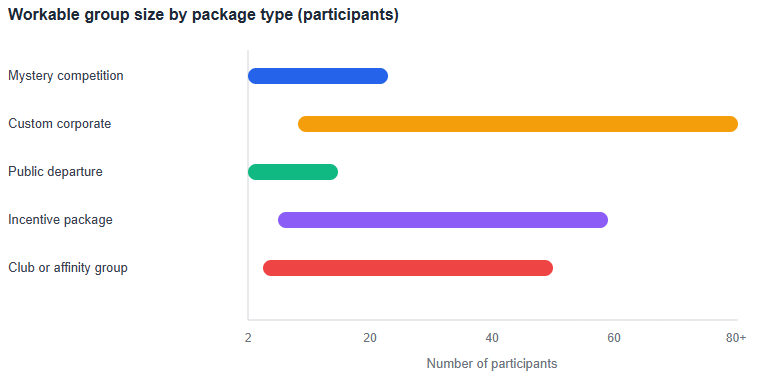
The mechanics are the same. Teams of two or three, up to ten teams travelling together, itinerary released less than 24 hours ahead, nobody eliminated. What changes is who is in the teams and how long it runs.
What the format actually fixes
Most corporate offsites fail in the same three ways, and the competition format addresses each one structurally rather than through facilitation.
- The agenda problem. People skim the schedule, decide which sessions to skip, and arrive disengaged. A hidden itinerary removes that option entirely.
- The seniority problem. Work from Harvard Business School ties high-performing teams to psychological safety rather than individual talent, and rank in the room works against it. In a workshop, the most senior person in the room talks most. In a challenge where nobody knows the answer, rank stops being useful and the person who is good at the task leads.
- The silo problem. Mixed teams of two or three force people who never work together into genuine dependence for several days, which is a different thing from being seated together at dinner. Deloitte's work on what teams lose when some voices dominate points the same way.
Our piece on creative Amazing Race team building challenges goes into how individual challenges are designed, and competitive travel experiences for corporate teams covers the range of formats.
When this is the wrong choice
Worth saying plainly, because the format does not suit every group.
- You need decisions made. If the offsite exists to settle strategy, run the working sessions and use a competition for the evenings or the final day.
- The group is very large. The format tops out around ten teams. Beyond roughly 30 people it needs splitting into parallel departures.
- Genuine mobility or medical constraints across much of the group. These are collected in advance and designed around, but a group with substantial constraints may be better served by a static venue.
- Your team is newly formed and anxious. Competition sharpens existing dynamics. It is excellent for teams that know each other and need shaking up, less so for strangers on day three.
Cost compared with a conventional incentive trip
Against the IRF benchmark of $5,100 per person, a competition format tends to land lower for the same number of days, for a structural reason: the budget goes into challenge design and logistics rather than resort rates and gifting. The two biggest line items in a traditional incentive programme, the property and the gift, are the two that a competition does not lean on. Teams stay in solid mid-range hotels in smaller towns, and the memorable part is what happened on day four rather than what was in the welcome bag.
For a sense of how the operators compare on price and format, see our roundup of Amazing Race vacation package companies.
The TLDR on Amazing Race style corporate trips
An Amazing Race style corporate trip splits colleagues into teams of two or three, sends them through a region on an itinerary released less than 24 hours ahead, and scores them on daily hands-on challenges. Up to ten teams travel together and nobody is eliminated. Formats run from a half day to a week. It solves the three standard offsite failures: skippable agendas, seniority dominating the room, and departments staying in their silos. It is a poor fit when the offsite needs to produce decisions, or when the group is much larger than 30. Competitours has run the format as corporate team travel since 2009.
Frequently asked questions
How many people can take part?
Up to ten teams of two or three travel on one departure, so roughly 20 to 30 people. Larger groups split across parallel departures.
How long does a corporate programme run?
From a half day event through to a week-long incentive trip. The full travel competition format needs at least three days to work properly; shorter versions run as single-city events.
Can we choose the destination?
You choose the region and the dates. The itinerary within it stays hidden from participants, which is the part that makes the format work. See custom trips for how that is built.
Do the challenges relate to our business?
They can carry company themes, product knowledge or values, though the strongest challenges tend to be the ones with nothing to do with work. People reveal more about how they solve problems when the problem is unfamiliar.
What if someone is not competitive?
Nobody is eliminated and the scoring is light enough that teams who stop caring about points still have a full trip. In practice the people who claim not to be competitive are reliably the most competitive by day three.
Is this just team building with travel attached?
No. Local team building activities are an afternoon in your own city. This is multi-day team travel across a region, where the travel itself is the thing being competed over. The two are often confused and they are not the same product.
How far ahead do we need to book?
Three to six months for a multi-day programme, longer for peak season. Shorter corporate formats can often be arranged with less notice.
What do participants actually say afterwards?
See what customers say about Competitours.
Related reading: Amazing Race vacations, 25 Amazing Race ideas for adults, and experiential travel packages for corporate teams.
Talk to Competitours about corporate team travel, or see how team travel works.