Table of Contents
- Why competitive travel works better than a standard offsite
- Comparing the main formats
- 1. The multi-day mystery team travel competition
- 2. Custom-built corporate competitions
- 3. Global scavenger hunts
- 4. Amazing Race style vacation formats
- 5. Hybrid incentive trips
- Practical planning notes
- What to ask before you book
- FAQ
TLDR: The best competitive travel experiences for corporate teams are multi-day, mystery-itinerary trips where small teams earn points through creative challenges instead of physical feats. Competitours runs this format as team travel across Europe and beyond, with daily itineraries revealed less than 24 hours in advance, teams of two to three people, and scoring that keeps almost every group in contention until the final day. Formats worth comparing include mystery team travel competitions, city-based race days, global scavenger hunts, custom-built corporate itineraries, and hybrid incentive trips.
Why competitive travel works better than a standard offsite
Most corporate offsites fail in the same predictable way: people fly somewhere pleasant, sit in a rented conference room, do a trust exercise nobody asked for, then eat dinner with the same four colleagues they already eat lunch with. Nothing changes on Monday.
Competitive travel breaks that pattern because it forces new pairings and gives people a reason to actually depend on each other. When a marketing manager and a backend engineer have ninety minutes to solve a challenge in a town neither of them can pronounce, hierarchy stops mattering very quickly. Research on team performance consistently points the same direction: shared goals and genuine interdependence do more for collaboration than any personality workshop.
There is also an engagement angle. Gallup's ongoing work on employee engagement has long shown that connection to colleagues is one of the strongest predictors of whether people stay and put in real effort. A competitive trip manufactures those connections faster than eighteen months of Slack threads.
Comparing the main formats
Not every competitive travel experience delivers the same thing. Some are great for a one-day energy boost; others actually reshape how a department works together. The chart below is a rough planning framework, not survey data: it reflects how these formats typically stack up when organizers weigh cross-department mixing against how long the effects last.
1. The multi-day mystery team travel competition
This is the format Competitours built its name on, and it is the strongest option for companies that want more than a fun photo album. Teams of two or three travel through a region together, receive each day's itinerary with less than 24 hours notice, and compete in creative challenges that reward lateral thinking rather than athleticism. A team travel competition run this way puts everyone on equal footing, because nobody can prepare in advance and nobody's job title helps.
The scoring design matters more than people expect. Because no team is ever eliminated and points come from varied sources, roughly 85% of teams are historically still in contention going into the final day. For a corporate group, that means your quietest department never checks out on day two.
2. Custom-built corporate competitions
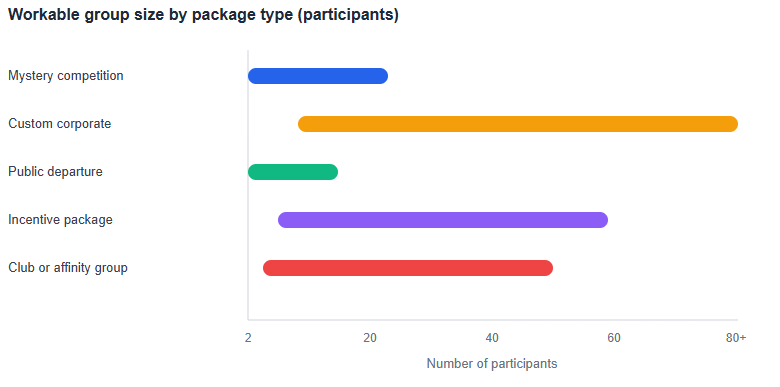
Some companies need the trip shaped around a specific goal: integrating two teams after an acquisition, rewarding a sales cohort, or getting a distributed engineering group into the same time zone for once. A custom trip lets you set the region, the length, the difficulty, and the mix of challenge types while keeping the mystery element that makes the whole thing work.
This is also the right route when you have logistical constraints that a public departure cannot flex around, such as accessibility needs, dietary requirements at scale, or a hard budget ceiling per head.
3. Global scavenger hunts
A global scavenger hunt spreads teams across multiple cities or countries with a task list to complete. It skews more toward logistics and speed than toward creativity, which suits operations-heavy teams and sales organizations that already thrive on a leaderboard. The tradeoff is that the fastest team often wins, and speed favors the same people who already win at everything else in your office.
4. Amazing Race style vacation formats
For groups that specifically want the televised feel, Amazing Race vacations deliver the recognizable structure of legs, clues, and detours without the twenty-two day commitment or the bug eating. Competitours deliberately avoids big cities and tourist hotspots here, routing teams through smaller towns where the challenges feel earned rather than staged for a crowd.
5. Hybrid incentive trips
If the trip doubles as a reward for hitting a number, you want competition without pressure. Hybrid incentive formats keep the challenge structure light, add more downtime, and lean on the travel itself. Competitours has run this shape for corporate incentive groups, and it pairs well with the broader menu of team travel ideas if you are still deciding what your group actually wants out of the week.
Practical planning notes
- Team size: pairs and trios beat groups of six. Larger teams let people hide.
- Trip length: four to seven days is the sweet spot. Under three days, people are still in airport mode; past eight, fatigue outruns enthusiasm.
- Pairing strategy: assign teams across departments rather than letting people self-select, or you will simply relocate your existing cliques.
- Budget: factor flights separately from the program cost, and confirm what is bundled. Industry bodies like the GBTA publish useful benchmarks for corporate travel spend if you need to defend the number internally.
- Leadership participation: executives should compete, not observe. Nothing flattens a team-building trip faster than a manager standing on the sidelines with a clipboard.
What to ask before you book
Ask how challenges are scored, whether teams can be eliminated, how much walking is involved on a typical day, and what happens if someone gets sick mid-trip. Ask whether the operator has run corporate groups before or mostly handles consumer bookings, because the two require very different levels of documentation and contingency planning. And ask to see a sample day, even if the real itinerary stays secret.
FAQ
What is the best competitive travel experience for a corporate team?
A multi-day mystery itinerary competition works best for most corporate groups, because it mixes departments, sustains engagement across several days, and rewards creativity over physical ability. Competitours runs this as team travel through under-the-radar regions, with each day revealed less than 24 hours ahead.
How many people can join a corporate competitive travel trip?
Competitours typically runs up to 10 teams of two, so roughly 20 participants per departure. Larger companies usually split into multiple departures or commission a custom program built for their headcount.
Do participants need to be athletic?
No. Competitours challenges are built around creativity, problem solving, and willingness to step outside your comfort zone rather than strength or endurance. Participants have ranged in age from 16 to 76.
How long should a corporate competition trip be?
Four to seven days is ideal. That gives enough time for teams to move through the awkward first day, hit their stride, and build the shared history that carries back to the office.
Can we choose the destination?
Partly. You can select the region, such as Western Europe or Central America, and the specific routing stays a surprise. Custom corporate programs give you more control over region, dates, and challenge mix while keeping the mystery element intact.
Is competitive travel appropriate for a team with mixed fitness and mobility levels?
Yes, particularly on custom programs where challenge types can be adjusted in advance. Flag mobility needs during planning so the itinerary is built around them rather than patched later.
How far in advance should we book?
Six to nine months for a custom corporate trip, since flights, accommodation, and challenge logistics across multiple towns all need lead time. Public departures can sometimes be joined on shorter notice.