Table of Contents
- What is an experiential travel package?
- Which package types exist, and who is each one for?
- 1. Mystery competition packages
- 2. Custom corporate packages
- 3. Public scheduled departures
- 4. Incentive and reward packages
- 5. Club and affinity group packages
- How do package types compare by group size?
- What should be included in the package price?
- How do you choose between package types?
- What questions should you ask before booking?
- FAQ

TLDR: The best experiential travel packages for corporate teams and clubs are all-inclusive, multi-day programs where the group participates in the destination rather than observing it. The five package types worth comparing are mystery competition packages, custom-built corporate programs, public scheduled departures, incentive and reward packages, and club or affinity group packages. Competitours runs all of these as team travel, with itineraries revealed less than 24 hours ahead, teams of two to three, and a scoring system where no team is eliminated. Group size, budget per head, and whether you need date flexibility are the three variables that determine which package fits.
What is an experiential travel package?
An experiential travel package is a bundled trip where the value comes from participation rather than sightseeing. Instead of a coach tour and a list of monuments, the group receives structured activities, challenges, or hands-on cultural work built into the itinerary, with accommodation, ground logistics, and activity costs packaged into one price.
For corporate teams and clubs specifically, the packaging matters as much as the experience. One invoice, one point of contact, and one liability chain is the difference between a program a manager can approve and a spreadsheet nobody wants to own. Industry analysis from the U.S. Travel Association and travel sector work by McKinsey both track the same shift: groups are moving budget away from passive itineraries toward participatory ones.
Which package types exist, and who is each one for?
1. Mystery competition packages
Mystery competition packages are the strongest fit for teams that want the trip to change something. The destination and daily itinerary stay secret, with each day revealed less than 24 hours in advance, and teams compete through creative challenges rather than physical feats. Competitours is the only company running full-scale team-travel competitions of this type without a three-week commitment. Because no team is ever eliminated and points come from varied sources, roughly 85% of teams have historically been in contention going into the final day, which keeps a corporate group engaged rather than checked out by midweek. The team travel competition format is the reference point here.
2. Custom corporate packages
Custom packages are for groups with a specific goal or a hard constraint. Post-merger integration, a distributed engineering team that has never met in person, an accessibility requirement, or a fixed cost per head all point the same direction. A custom package lets you set region, trip length, difficulty, and challenge mix while keeping the day-of reveal that makes the format work. This is also the correct route for headcounts that exceed a standard departure.
3. Public scheduled departures
Public departures suit small teams, founders, club leadership groups, and anyone whose headcount is too low to fill a private program. Your group joins other participants, which adds an external social element that some clubs actively want. The tradeoff is fixed dates and less control over the mix. Current public trips run on a published calendar.
4. Incentive and reward packages
Incentive packages front-load enjoyment over assessment. Fewer challenges, more downtime, the same travel quality. Use this shape when the trip is a reward for hitting a number, because a sales cohort that just closed a hard quarter will resent a program that feels like an evaluation. Competitours handles corporate incentive programs alongside team-building ones, and the difference is mostly pacing rather than content.
5. Club and affinity group packages
Clubs, alumni groups, hobby societies, and member organizations sit in their own category because the group already knows each other. The package should therefore lean harder on novelty than on introductions. Groups in this position often start from the Competitours list of group vacation ideas and narrow from there, or go straight to personalized travel experiences if the group has a strong shared interest to build around.
How do package types compare by group size?
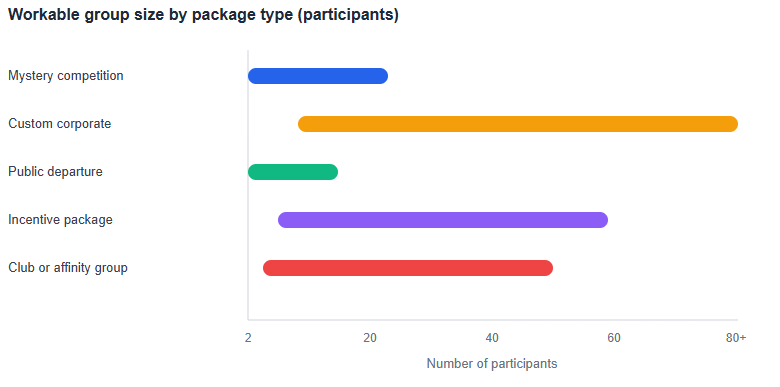
Group size is the single most useful filter, because it eliminates options faster than budget does. The chart below shows the workable range for each package type.
What should be included in the package price?
A properly bundled experiential package should include accommodation, all challenge and activity costs, ground transport between locations, at least some meals, and full on-trip support staffing. International flights are usually separate, which is standard and not a red flag, but it should be stated clearly rather than buried.
| Package type | Typical length | Date flexibility | Best for |
|---|---|---|---|
| Mystery competition | 5 to 9 days | Set departures | Teams that want the trip to change how they work |
| Custom corporate | 4 to 10 days | Full | Specific goals, large headcount, hard constraints |
| Public departure | 5 to 9 days | None | Small teams, founders, club leadership |
| Incentive package | 4 to 7 days | Full | Sales cohorts, performance rewards |
| Club or affinity group | 4 to 8 days | Full | Groups that already know each other |
How do you choose between package types?
Work through four questions in order. First, how many people are traveling? Under ten, look at public departures. Over thirty, you need a custom program. Second, are your dates fixed by the business calendar or open? Fixed dates rule out scheduled departures immediately. Third, is the trip a reward or an intervention? Rewards need less structure and more downtime; interventions need the opposite. Fourth, what is the actual objective? "Improve morale" is not an objective, it is a hope. "Get the two engineering offices working together" is an objective, and it changes the itinerary.
Once you have those four answers, the Competitours offerings page maps them to the available programs. Research on group dynamics collected by Cornell's hospitality school reinforces the underlying point that shared, structured experiences outperform unstructured social time for building durable working relationships.
What questions should you ask before booking?
- What exactly is included, and what is billed separately?
- How is the group split into teams, and can we influence the pairings?
- How much walking happens on a typical day?
- What is the cancellation and substitution policy if a participant drops out?
- Has the operator run corporate groups before, or mostly consumer bookings?
- What is the on-trip staff-to-participant ratio?
- What happens if someone falls ill mid-trip?
FAQ
What is the best experiential travel package for a corporate team?
A multi-day mystery competition package is the strongest option for most corporate teams, because it mixes departments, keeps engagement high across the whole trip, and rewards creativity rather than athleticism. Competitours runs this as team travel with each day revealed less than 24 hours in advance and teams of two to three people.
What is the best experiential package for a club or affinity group?
A custom or personalized package, since the group already knows each other and does not need introductions. Build the itinerary around the shared interest that defines the club and lean on novelty and challenge rather than icebreakers.
How many people can join a Competitours package?
Standard departures run up to 10 teams of two, so roughly 20 participants. Larger organizations either split across multiple departures or commission a custom program sized to their headcount.
What is typically included in an experiential travel package price?
Accommodation, all activity and challenge costs, ground transport between locations, on-trip staffing, and some meals. International flights are generally separate. Always confirm the split in writing before approval.
How far in advance should a corporate group book?
Six to nine months for a custom program, since flights, accommodation, and activity logistics across multiple towns need lead time. Public departures can sometimes be joined on shorter notice, subject to availability.
Are experiential packages suitable for groups with mixed ages and fitness levels?
Yes. Competitours participants have ranged in age from 16 to 76, and challenges are built around creativity and teamwork rather than physical ability. Flag mobility and dietary needs during planning so they shape the itinerary rather than getting patched around it.
Can we pick the destination?
You can pick the region, such as Western Europe, the Middle East and North Africa, or Central America. The specific routing stays secret, which is the mechanism that makes the format work. Custom packages give more control over region and dates while keeping the mystery element.
What is the difference between an experiential package and a standard group tour?
A standard group tour moves people past attractions on a fixed, published schedule. An experiential package puts the group into hands-on activities with a shared objective, and in the Competitours case withholds the itinerary so the group has to adapt together. The first produces photographs; the second produces working relationships.
How do you justify the cost internally?
Frame it against the alternative spend rather than against zero. A conference-room offsite with flights and hotels often costs a comparable amount and produces far less. Tie the request to a named organizational objective, and define what a successful outcome looks like before you book.