Table of Contents
- How a travel competition works
- Travel competition vs guided tour vs independent travel
- Why the category is growing
- Who travel competitions suit
- What a travel competition is not
- The TLDR on travel competitions
- Frequently asked questions
- What is a travel competition?
- Is a travel competition the same as an Amazing Race style trip?
- Do you have to be fit to take part?
- Can you lose?
- How long does a travel competition last?
- How is it different from booking a tour?
- Where do Competitours trips go?
By Ari Charlestein | Updated November 2026
A travel competition is a trip where teams travel the same route and compete in challenges along the way, scoring points rather than simply sightseeing. The itinerary is usually kept secret until shortly before each day begins, so nobody can research ahead or plan their way to an advantage. Competitours has run this format as team travel since 2009, and it sits somewhere between a guided tour, a treasure hunt and an escape room that happens to span several countries.
The format gets described in a lot of ways: competitive travel, an Amazing Race style trip, a mystery itinerary competition, team travel. They mostly mean the same thing. This page explains what the format actually involves, how it differs from a tour, and who it suits.
How a travel competition works
Three things define the format, and a trip missing any of them is really a guided tour with a quiz attached.
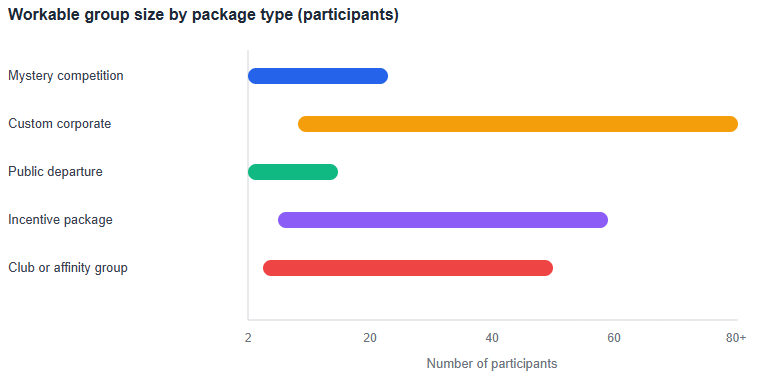
- Teams, not a tour group. Travellers enter in small teams. On a Competitours departure that means two or three people per team, with up to ten teams travelling together. Teams move through the same region but make their own choices within each day.
- A hidden itinerary. Each day's plan is released less than 24 hours before it starts. You know the region and the dates; you do not know the city, the challenge or the route.
- Scored challenges. Each day brings hands-on tasks that earn points. Cooking something local, solving something on foot, making something, finding something. Nobody is eliminated, so a bad morning does not end anyone's trip.
Scoring is what changes the experience. On a guided tour everyone sees the same thing at the same pace. In a competition, two teams in the same town have different days depending on the decisions they make.
Travel competition vs guided tour vs independent travel
| Guided tour | Independent travel | Travel competition | |
|---|---|---|---|
| Who plans it | Operator | You | Operator, revealed daily |
| You know the itinerary | At booking | You wrote it | Under 24 hours ahead |
| Group structure | One coach group | Just you | Small competing teams |
| Daily pace | Fixed for everyone | Entirely yours | Set by the challenge |
| Planning workload | None | High | None |
| Meet other travellers | Incidental | Unlikely | Built into the format |
The honest summary: a tour removes the planning but also the agency. Independent travel gives you agency at the cost of weeks of research. A competition removes the planning and replaces the agency with a daily problem to solve.
Why the category is growing
Competitive and active travel sits inside the broader adventure travel market, the sector tracked by the Adventure Travel Trade Association, which the research firm Mordor Intelligence puts at $514.53 billion in 2026, growing to a forecast $841.73 billion by 2031. That is a compound annual growth rate of 10.34%, well ahead of travel generally.
| Year | Adventure tourism market size |
|---|---|
| 2025 | $467.34 billion |
| 2026 | $514.53 billion |
| 2031 (forecast) | $841.73 billion |
Source: Mordor Intelligence, Adventure Tourism Market Size and Share. Friends and group travellers make up 34.6% of that market, the largest single traveller segment.
Who travel competitions suit
The format works for people who find a coach tour too passive and planning a trip from scratch too much work. In practice that covers a wide range: Competitours participants have ranged in age from 16 to 76, and a single departure often has couples, families and groups of friends competing against each other.
- Couples who want something to do together rather than a beach. Our guide to mystery trips for couples covers how pairs usually approach it.
- Friend groups who struggle to agree on an itinerary. Having it chosen for you removes the argument entirely. See travelling with friends.
- Work teams, where the competition does the job an offsite agenda usually fails at. Corporate team travel runs on the same format.
- Repeat travellers who have done the obvious capitals. Competitions tend to route through smaller towns, because that is where the challenge design works.
What a travel competition is not
It is not a reality show, though National Geographic once called the format the Amazing Race for regular people. There are no cameras, no eliminations and no production crew. It is not an endurance event either: the challenges are hands-on and mental rather than physical, and you do not need to be an athlete. And it is not a mystery flight, where an operator picks one destination and you find out at the airport. A competition hides the whole itinerary and releases it a day at a time across a region, so the surprise renews every morning instead of ending on arrival. If the single-destination version is what you are after, our roundup of surprise vacation companies compares the operators.
The TLDR on travel competitions
A travel competition is a trip where small teams follow a hidden itinerary and score points in daily hands-on challenges. The destination region is known at booking; each day's plan is released less than 24 hours ahead. Competitours runs the format as team travel with teams of two or three, up to ten teams per departure, for travellers aged 16 to 76, with nobody eliminated. It suits people who want a trip planned for them but do not want to be led around in a group. The category sits inside adventure travel, which is growing at 10.34% a year.
Frequently asked questions
What is a travel competition?
A trip where teams travel the same region and compete in scored challenges, with the itinerary hidden until shortly before each day begins. It combines the convenience of a planned trip with the agency of solving something yourself.
Is a travel competition the same as an Amazing Race style trip?
Broadly yes. "Amazing Race style" is how most people describe the format, after the television show. Our Amazing Race vacations page covers that framing in detail.
Do you have to be fit to take part?
No. Challenges are hands-on and mental rather than athletic, and Competitours participants have ranged from 16 to 76. Mobility needs are collected before the trip and factored into the route.
Can you lose?
Teams are scored and ranked, but nobody is eliminated. Every team travels the full itinerary regardless of position, so a weak day costs points and nothing else.
How long does a travel competition last?
Competitours departures typically run seven to ten days across one region. Corporate formats run shorter, from a half day upward.
How is it different from booking a tour?
A tour tells you the itinerary at booking and moves everyone together at one pace. A competition withholds the itinerary and splits travellers into teams making their own decisions, so two teams in the same town have different days.
Where do Competitours trips go?
Regions rather than single cities, mostly across Europe, North America and Central America. See scheduled departures for upcoming dates, or custom trips if you are building a group of your own.
See how the challenges work, or talk to Competitours about a team travel departure.