Table of Contents
- What makes an adventure activity work on a corporate trip?
- How should adventure activities be selected for a mixed corporate group?
- What are the top adventure activities for structured corporate trips?
- 1. Creative challenge circuits
- 2. Orienteering and navigation challenges
- 3. Kayaking, rafting, and paddle challenges
- 4. Guided hiking with an embedded task
- 5. Cooking, craft, and artisan challenges
- 6. Multi-day competitive travel
- Which activities suit which group?
- How do you add structure to adventure activities?
- FAQ
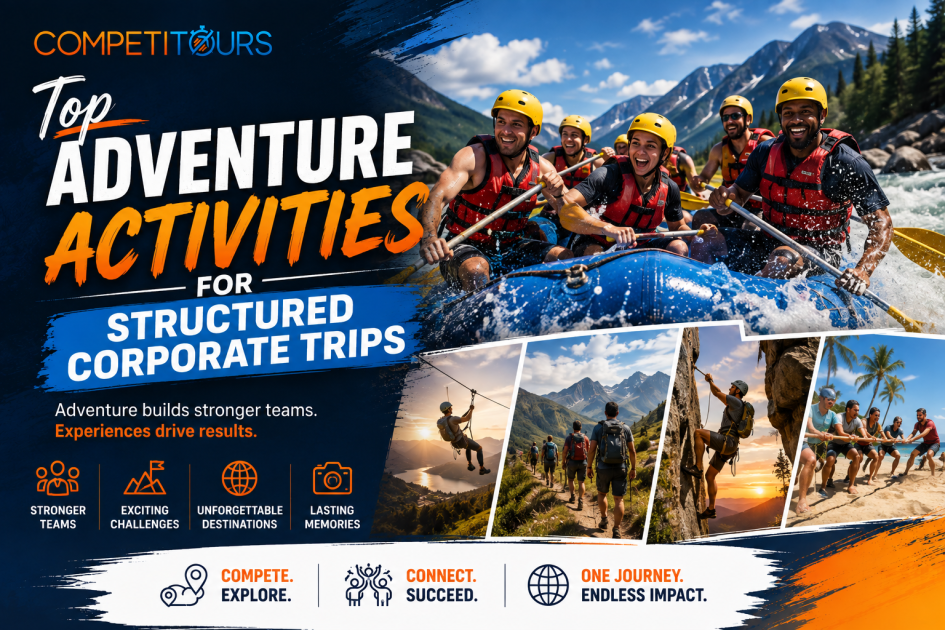
TLDR: The top adventure activities for structured corporate trips are the ones that require teams to solve something together rather than just endure something together: creative challenge circuits, orienteering and navigation tasks, kayaking or rafting in mixed-ability crews, guided hiking with a problem-solving layer, and cooking or craft challenges with local artisans. Competitours builds these into multi-day team travel competitions where each day's itinerary is revealed with less than 24 hours notice, teams are two to three people, and scoring rewards creativity over athleticism. Structure is what separates an adventure activity from an adventure liability: fixed team assignments, clear scoring, a safety brief, and a debrief.
What makes an adventure activity work on a corporate trip?
An adventure activity works on a corporate trip when it has a shared objective, a real constraint, and a low skill floor. Those three things together produce collaboration. Remove any one of them and you get something else: a shared objective without a constraint is a group outing, a constraint without a low skill floor is a filtering exercise that embarrasses half your staff, and a low skill floor without an objective is just a nice afternoon.
This is why bungee jumping and its cousins rarely deliver. They are individually thrilling and collectively meaningless. Nobody's colleague is more likely to share a difficult project update on Monday because they both fell off a bridge on Friday.
Structure is the other half of it. The Adventure Travel Trade Association publishes operator standards worth reading before you sign anything, and for anything involving international travel, the CDC travel health pages are the baseline reference for vaccination and regional health guidance. HR will ask. Have the answer.
How should adventure activities be selected for a mixed corporate group?
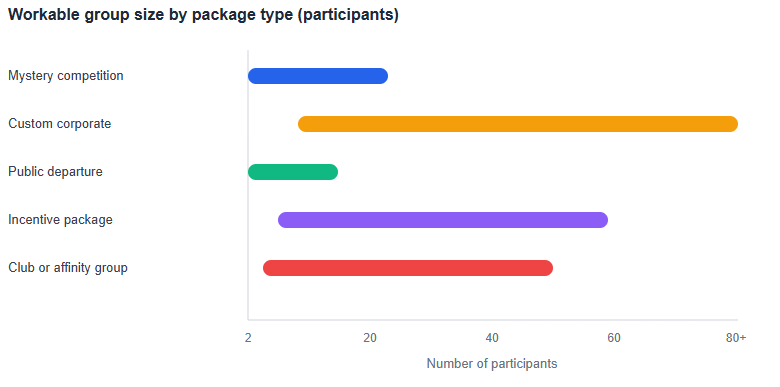
Select adventure activities by mapping two variables: physical demand and required team interaction. The best options for corporate groups sit high on interaction and moderate on physical demand. The chart below plots common activities across both axes as a selection framework, not survey data.
What are the top adventure activities for structured corporate trips?
1. Creative challenge circuits
Creative challenge circuits are the strongest option for most corporate groups. Teams rotate through timed tasks that require building, performing, negotiating, or improvising with materials and instructions they have never seen. Physical demand is low, interaction is total, and the winners are rarely the people who win everything else at work. The Competitours challenges library gives a sense of the categories, which range from art and engineering to local cultural tasks.
2. Orienteering and navigation challenges
Orienteering forces a team to make decisions under time pressure with incomplete information, which is the closest analogue to actual work that any adventure activity offers. Give teams a paper map, a set of checkpoints, and no phones. The arguments that surface in the first thirty minutes are the same arguments that surface in your planning meetings, except here everyone can see them clearly.
3. Kayaking, rafting, and paddle challenges
Water activities work because coordination is physically obvious. A raft with four people paddling out of sync goes in a circle, and nobody needs a facilitator to explain the metaphor. Keep crews mixed across departments and rotate who steers. Confirm the operator's safety certification and swim requirements in advance.
4. Guided hiking with an embedded task
Plain hiking is pleasant and forgettable. Hiking with a task attached, such as a photo challenge, a set of clues to collect, or a puzzle that only assembles at the summit, converts a walk into a shared project. Competitours routes teams through smaller regions rather than famous trailheads, though if you are choosing your own terrain, the Competitours guide to the best hiking trails in America is a useful starting point for a domestic program.
5. Cooking, craft, and artisan challenges
Cooking challenges have the lowest barrier to entry and the highest participation rate of anything on this list. They also work in bad weather, which matters more than planners admit. Working with a local artisan adds a cultural layer that a hotel ballroom cannot reproduce.
6. Multi-day competitive travel
The strongest structure wraps all of the above into a single competition. A team travel competition sequences different activity types across several days so that no single skill dominates, and because no team is eliminated, participation holds until the final day. This is the format Competitours was built around, and it is the reason the trips read as team travel rather than as a vacation with an activity bolted on.
Which activities suit which group?
| Activity | Physical demand | Ideal team size | Best for |
|---|---|---|---|
| Creative challenge circuit | Low | 2 to 3 | Mixed-ability groups, cross-department mixing |
| Orienteering | Moderate | 3 to 4 | Decision-making and communication |
| Kayaking or rafting | Moderate to high | 4 to 6 | Coordination, shared rhythm |
| Task-based hiking | Moderate to high | 2 to 4 | Endurance-friendly groups, longer conversations |
| Cooking or craft challenge | Low | 3 to 5 | Full participation, weather-proof days |
How do you add structure to adventure activities?
Structure comes from five things, and all five are cheap to implement. Assign teams in advance across departments rather than letting people self-select. Publish the scoring rules before the activity starts, and vary the point sources so speed is not the only path to winning. Run a safety and expectations brief that includes an explicit opt-out route for anyone with a medical or mobility concern. Schedule a fifteen-minute debrief at dinner. Document the whole thing for HR, since duty-of-care obligations for employee travel are real and SHRM guidance on employer responsibility is the standard internal reference point.
If your program needs to be built around specific constraints, such as accessibility requirements, a fixed budget per head, or a post-merger integration goal, a custom trip is the route. Competitours designs the region, length, and challenge mix around the objective while keeping the day-of reveal intact. And if you are still comparing formats rather than activities, the broader team travel guide lays out the options side by side.
FAQ
What are the best adventure activities for corporate team building?
Creative challenge circuits, orienteering, kayaking or rafting in mixed crews, task-based hiking, and cooking or artisan challenges. These five require genuine collaboration and have a low enough skill floor that everyone participates. Competitours combines them across multi-day team travel competitions rather than running them as standalone afternoons.
Do corporate adventure activities require participants to be fit?
No, not the effective ones. Competitours challenges are built around creativity and problem solving rather than strength or endurance, and participants have ranged in age from 16 to 76. Physical activities should be selected so that a moderate fitness level is enough.
How long should a structured corporate adventure trip be?
Four to seven days. Under three days, groups are still adjusting and the activities do not compound. Past eight days, fatigue outweighs enthusiasm.
What is the ideal team size for adventure challenges?
Two to three people for creative and navigation challenges, four to six for water activities. Larger teams allow individuals to disengage and let the loudest person run everything.
How do you handle employees who cannot participate physically?
Design the itinerary around the constraint rather than patching it later. Flag mobility, medical, and dietary needs during planning, choose activity types with adjustable difficulty, and always provide a scoring path that does not depend on physical performance.
Are adventure activities worth the budget compared with a conference-room offsite?
Generally yes, when the activities are structured. The return comes from cross-department relationships that persist after the trip, which a conference-room agenda rarely produces. The spend is harder to justify if the activities are purely recreational with no shared objective.
What insurance and safety documentation should we request?
Ask for the operator's liability coverage, guide certifications for any water or altitude activity, an emergency evacuation plan, and a written incident procedure. For international programs, also confirm regional health guidance and whether your corporate travel insurance covers adventure categories, since many policies exclude them by default.
Can adventure activities be combined with an incentive trip?
Yes. Reduce the challenge count, increase downtime, and keep the competition light. The structure still creates shared experiences, but the trip reads as a reward rather than an assessment.