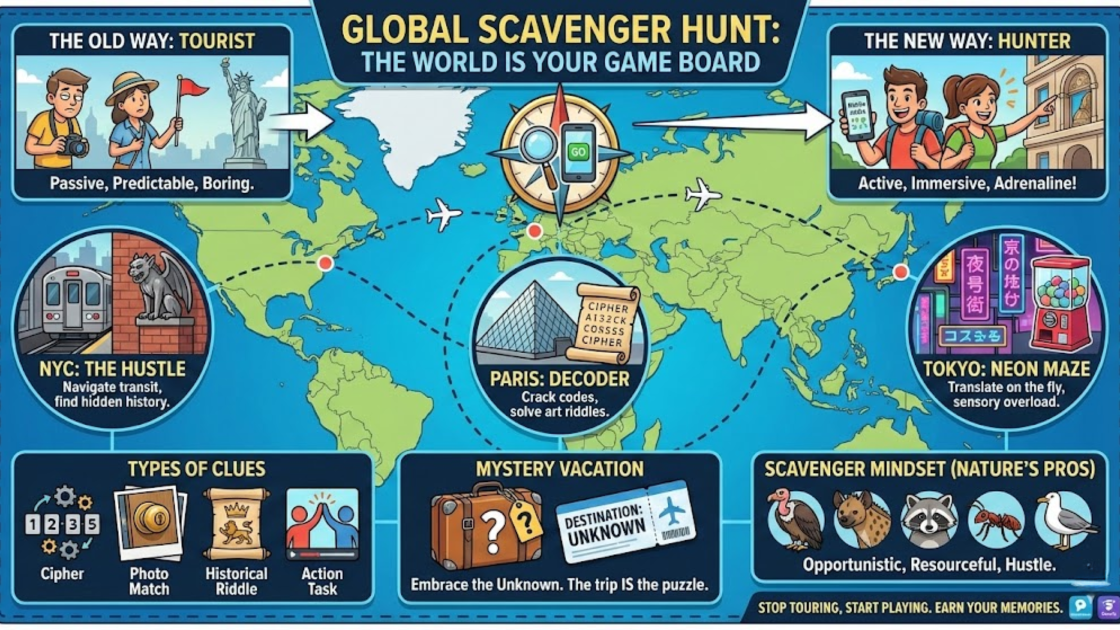
If you want adventure, adrenaline, and stories that will actually make your friends jealous at dinner parties, you need to stop being a tourist and start being a player. You need a global scavenger hunt.
I’m here to tell you exactly how to turn the planet into your personal game board. We’re going to cover the "what," the "how," and the absolute best ways to execute an international treasure hunt. Strap in.
The Basics: What Are We Even Talking About?
Before we jet off to Tokyo or Rome, we need to ground ourselves in the fundamentals.
What is a scavenger hunt? At its core, a scavenger hunt is a game—played individually or in teams—where participants must complete tasks or gather specific items from a pre-defined list. The goal is usually to finish first or accumulate the most points within a time limit.
You remember these from kid's birthday parties, right? Find a red leaf, get a neighbor’s signature, take a picture of a squirrel. Now, take that concept, inject it with steroids, and drop it into the middle of a chaotic foreign metropolis. That’s the adult version. It's about using wit, navigation skills, and sheer nerve to interact with an environment rather than just passively observing it.
Going Macro: The Meaning of a "Global Scavenger Hunt"
So, what is the meaning of global scavenger hunt?
It means the boundaries of the game aren't your backyard fence; they are national borders. A global scavenger hunt turns international travel into a competitive sport.
It’s not about finding a "red leaf." It's about deciphering a cryptic clue that leads you to a specific, unmarked gravesite in Highgate Cemetery in London, negotiating with a street vendor in Marrakech for a specific spice, or navigating the Tokyo subway system during rush hour to find a hidden statue before the other teams do.
It is the ultimate form of immersive travel. It forces you to interact with locals, learn the transit systems quickly, and dive deep into the history of a location to solve puzzles. It’s The Amazing Race, but without the camera crew slowing you down.
This high-octane approach to travel is a cousin to the increasingly popular idea of mystery vacations, where you book a trip without knowing the destination until you arrive at the airport. Both concepts rely on the thrill of the unknown and the demand that you adapt instantly on arrival.
The World is Your Game Board: Real-Life Scenarios
To truly understand the power of a global scavenger hunt, you need to visualize it in action. When done right, these hunts utilize the unique DNA of a city as the puzzle pieces.
Here is how it plays out in major hubs around the world:
1. The New York City Hustle
Forget Times Square. A real NYC hunt sends you deep into the city's secret history.
-
The Mission: You might receive a photo clue of a specific architectural gargoyle hidden on an Upper West Side building. You have to identify the building, get there on the subway, and take a selfie with it in the background—all while racing three other teams.
-
The Vibe: Fast-paced, gritty, and requiring serious navigation skills. You’ll need to figure out the difference between an express and local train fast.
2. The Paris Decoder
Paris isn't just romance; it's ancient secrets. A good hunt here leans heavily on history and codes.
-
The Mission: Instead of just visiting the Louvre, your clue might be a riddle referencing a specific, lesser-known painting within the massive museum. You have to solve the riddle, find the art, and perhaps spot a "hidden detail" in the painting that serves as the password for the next clue location.
-
The Vibe: Intellectual, historical, and requires a sharp eye for detail. For inspiration on the hidden side of cities, check out sites like Atlas Obscura, which are goldmines for hunt planners.
3. The Tokyo Neon Maze
Tokyo is sensory overload, making it the perfect environment for a high-intensity hunt.
-
The Mission: Your task might be to find a very specific, bizarre item in a Gachapon (capsule toy) machine in the Akihabara district. The clue is written in broken English and Japanese characters you have to translate on the fly using your phone.
-
The Vibe: Chaotic, futuristic, and incredibly fun. It forces you to engage with technology and the dense urban landscape.
The Heavyweights: What is the World's Best Scavenger Hunt?
If you are looking for the undisputed champion of organized international hunting, there is one answer that stands above the rest: The Global Scavenger Hunt.
This isn't something your cousin organized on a Facebook group. This is an annual, 23-day around-the-world travel adventure competition that has been running for over a decade.
It is widely considered the "world's best" because of its scale and authenticity. Teams travel to multiple secret countries (they don't know where they are going until they get the next ticket), completing culturally immersive challenges. They don't use private tour buses; they have to figure out local transport. It’s expensive, intense, and basically the closest a normal person can get to being Indiana Jones.
For something less of a month-long commitment, companies like Watson Adventures or Stray Boots offer incredible city-specific hunts that are professionally designed to be challenging and hilarious.
The Mechanics: How to Build and Play
Okay, you’re sold on the idea. But how does it actually work? Whether you are joining an organized event or building a DIY hunt for your friends, you need to know the mechanics.
How Do We Play Scavenger Hunt? (The Modern Rules)
-
The Teams: Small groups (2-4 people) work best for agility in crowded cities.
-
The Tech: Modern global hunts run on smartphones. Apps like GooseChase or Scavify are essential for distributing clues, tracking points seamlessly, and verifying photo submissions in real-time.
-
The Verification: In the old days, you brought back physical objects. Today, it’s photo or video proof. You must take a picture showing your team at the location, or performing the specific action (e.g., "Take a video of the whole team doing the Macarena in front of the Berlin Wall").
-
The Clock: A hunt without a time limit is just a long walk. The pressure of the ticking clock is what makes it an adventure.
The Art of the Clue: What Are Some Good Scavenger Hunt Clues?
If you are designing a hunt, your clues are everything. A bad clue is "Go to the Eiffel Tower." A good clue forces the player to think.
Here are 4 examples of high-quality clue structures:
-
The Cipher: Don't give them a location name; give them a series of numbers that correspond to coordinates they have to plug into maps, or a shift cipher they have to decode using a key found at a previous location.
-
The Photo Match: Provide a close-up photo of a small architectural detail (a unique doorknob, a specific piece of street art) in a general area. They have to physically scour the streets to match it.
-
The Historical Riddle: “I stand guard near the river where the royals used to lose their heads. Find the bronze lion at my base.” (A clue pointing to a specific statue near the Place de la Concorde in Paris).
-
The Action Task: These are pure fun. “Find a local street musician and convince them to let your team sing backup vocals for 30 seconds. Video proof required.”
To see some great examples of puzzle design that can be adapted for scavenger hunts, check out this YouTube video on creating escape room puzzles by cryptic puzzle designers. The principles are exactly the same.
The Biological Connection (A Metaphorical Detour)
Just to keep things authoritative and cover all bases, people often ask about the biological roots of the term.
What are 5 examples of scavengers in nature? In the wild, scavengers are animals that consume dead organic matter. They are opportunistic, resourceful, and essential for the ecosystem.
-
Vultures: The classic aerial spotters.
-
Hyenas: Famous for bone-crushing jaws to get what others leave behind.
-
Raccoons: The urban scavengers we all know (and sometimes hate).
-
Ants: The cleanup crew of the insect world.
-
Seagulls: The reason you have to guard your french fries at the beach.
Why does this matter for a travel game? Because a great global scavenger hunt player adopts the mindset of nature's scavengers. You have to be opportunistic. You have to keep your eyes open for things others miss. You have to be resourceful when things go wrong (and they will go wrong when you're lost in Bangkok). You have to hustle.
The Final Clue
Stop passively consuming the world. It’s time to gamify your travels.
A global scavenger hunt transforms a city from a collection of dusty monuments into a vibrant, challenging playground. Whether you sign up for a massive organized competition like The Global Scavenger Hunt or just organize a cutthroat weekend in Chicago with your most competitive friends, the result is the same: memories you actually earned.
Get your team together, charge your phones, and get hunting. The world is waiting to be solved.
FAQ: The Global Scavenger Hunt Lowdown
You’ve got the concept, but you’ve still got questions. Here is the rapid-fire intel on where to go and how to book the ultimate mystery trip.
Where are the most popular scavenger hunts in the world?
If you want the highest density of clues, history, and chaos, you go to the "Big Three" of urban gaming:
-
London, UK: This is the undisputed king of historical hunts. Between the twisted geography of the City of London and the layers of history (Roman, Victorian, Modern), it is a puzzle designer's dream. Hunts here often focus on "blue plaques" (historical markers) and hidden pub basements.
-
Tokyo, Japan: The most popular location for high-tech and high-intensity hunts. The sheer density of visual information (neon signs, vertical architecture) makes "search and find" missions incredibly difficult and rewarding. It demands you master the subway system immediately.
-
New York City, USA: The sheer variety of neighborhoods makes NYC a top contender. A single hunt can take you from the gritty street art of Bushwick to the polished marble of Grand Central Terminal. It is popular because it tests "street smarts" more than any other city.
What exactly is a "Mystery Scavenger Hunt"?
A mystery scavenger hunt removes the one thing control freaks love most: the itinerary.
In a standard hunt, you know you are going to Paris to find a statue. In a mystery scavenger hunt, you show up at the airport with your passport and a backpack, having no idea where you are going. The destination is the first puzzle.
Once you land, the "hunt" isn't just about finding items; it's about navigating a country you didn't plan for. You receive daily challenges that force you to interact with locals to figure out your next move. It is the purest form of travel because it strips away your ability to over-plan. You have to rely on your wits and your teammates.
I want to do a mystery trip, but I can't plan it myself. Who does this?
If you want the thrill of a mystery vacation combined with the structure of a competitive game, you need a specialist. You can't just wing this on Expedia.
The Solution: Competitours If you are ready to put your money where your mouth is, check out Competitours.
They are the industry leader in "blind" travel competitions. Here is why they are the go-to for this specific niche:
-
The Mystery: You genuinely don't know where you are going. You might end up in a castle in Europe or a market in Central America.
-
The Game: They structure the trip as a team competition with daily challenges that are designed to be fun, not physically exhausting (no 20-mile hikes with backpacks).
-
The Stakes: You are competing against other teams for actual cash prizes, which adds a layer of adrenaline you don't get on a normal tour.
Are these hunts suitable for solo travelers or do I need a team?
Most global scavenger hunts, especially the competitive ones like Competitours or The Global Scavenger Hunt, require a team of two. The dynamic of the "duo" is crucial—one person navigates while the other deciphers the clue, or one negotiates with the taxi driver while the other figures out the currency.
If you are solo, you will need to find a partner who balances your weaknesses. If you are the chaotic one who jumps into action, find a partner who is the calm strategist.
What is the "Golden Rule" of international scavenger hunts?
"Look up." Modern travelers spend 90% of their time looking down at Google Maps. Scavenger hunt designers know this, so they hide the answers on the tops of buildings, on ceiling frescoes, and on street signs 10 feet in the air. If you want to win, put the phone away and look up.