Table of Contents
- Demand is there; the coordination is the problem
- What actually changes as the group grows
- The sub-team structure
- The five logistics questions worth settling first
- Why a hidden itinerary removes most of the argument
- The TLDR on team travel for groups of 6 to 30
- Frequently asked questions
- What is the maximum group size?
- What is the minimum?
- Can we choose our own teams?
- Does everyone need to fly from the same city?
- What if people have very different fitness levels?
- How far ahead should a group of this size book?
- Can a group book a private departure rather than joining a public one?
- Does this work for a company rather than a friend group?

By Ari Charlestein | Updated November 2026
Group trips fail at the planning stage, not on the trip. Six people cannot agree on a destination, twelve cannot agree on a budget, and thirty generate a spreadsheet nobody maintains. The trip either shrinks to four people or quietly dies in a group chat. Competitours has been running team travel for groups this size since 2009, and the logistics are the part most people underestimate.
This page covers what actually changes as a group grows, where the coordination genuinely breaks, and how a competition format handles it differently from a conventional group booking.
Demand is there; the coordination is the problem
Group travel is growing. The U.S. Travel Association found that 86% of business travellers expect to take more group trips in 2026, and 72% plan to attend at least two meetings during the year. On the leisure side, friends and group travellers now make up 34.6% of the adventure travel market according to Mordor Intelligence, the largest single traveller segment.
| Finding | Share of business travellers |
|---|---|
| Expect to take more group trips in 2026 | 86% |
| Plan to attend at least two meetings in 2026 | 72% |
Source: U.S. Travel Association, U.S. Group Travel Report.
The appetite is not the constraint. The constraint is that somebody has to do the work, and in most friend groups and small companies that somebody is a volunteer with a day job.
What actually changes as the group grows
| Group size | What breaks first | What it needs |
|---|---|---|
| 6 to 8 | Agreeing on a destination | Someone to decide, or a format that decides for you |
| 9 to 14 | Budget spread between participants | A fixed per-person price with everything included |
| 15 to 20 | Moving the group between cities | Pre-booked transport, not day-of decisions |
| 21 to 30 | Nobody knowing where anyone is | Sub-teams with their own schedules |
The pattern worth noticing: each break is a coordination problem, not a cost problem. Groups rarely collapse because the trip is too expensive. They collapse because one person is carrying forty decisions and gets tired.
The sub-team structure
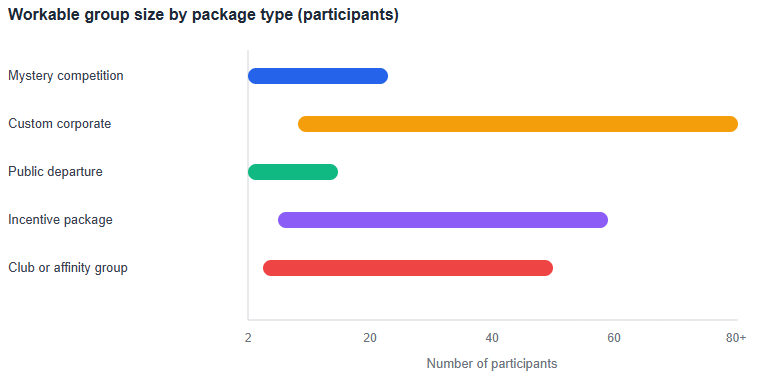
This is the part that scales. Competitours splits any group into teams of two or three, with up to ten teams on a departure. That caps a 30-person trip at ten units to coordinate rather than thirty individuals, and each unit makes its own decisions within the day.
The practical effect is that a group of 24 never moves as a block. Nobody waits in a hotel lobby for the slowest person, because there is no single group to be slow. Teams start together, solve their own day, and meet again in the evening.
It also fixes the quiet problem in every large friend group, which is that people want different trips. The couple who wants to walk 15 kilometres and the pair who wants to sit in a café can be on the same trip without negotiating, because they are on different teams solving the same challenge their own way.
The five logistics questions worth settling first
- Who holds the money? Decide before anyone books flights. A fixed per-person price paid to an operator avoids the friend who fronts €4,000 and spends six months chasing it.
- What is the real budget floor? Not the average. The lowest budget in the group sets the trip, and finding that out early is kinder than finding out in month three.
- Who cannot do what? Dietary needs, mobility, anyone who cannot take a specific week off. Collect it in one pass at the start, quietly. The State Department checklist is a useful prompt for passports and documentation across a group.
- How do people get there? Groups of this size rarely fly from one city. Agree a meeting point and time, and let people route themselves to it.
- What happens if someone drops out? At 6 to 30 people, somebody always does. Know whether the price per person moves and who absorbs it.
Our packing checklist covers the individual preparation, and group vacation ideas covers formats beyond the competition one.
Why a hidden itinerary removes most of the argument
The single most expensive part of planning a group trip is the destination debate. It burns weeks, generates the most friction, and often ends with a compromise nobody wanted.
A team travel competition removes it structurally. Participants know the region and the dates; the itinerary within it is released less than 24 hours ahead. There is nothing to vote on, so nobody has to lose a vote. For groups that have failed to get a trip off the ground before, this tends to be the deciding factor rather than the competition itself.
The format also handles mixed ages well. Competitours participants have ranged from 16 to 76, and a group of 20 can include grandparents and teenagers on different teams without anyone being dragged along.
The TLDR on team travel for groups of 6 to 30
Group trips break at the coordination stage, not the cost stage, and what breaks changes with size: destination agreement at 6 to 8, budget spread at 9 to 14, inter-city transport at 15 to 20, and knowing where people are at 21 to 30. The structural fix is sub-teams. Competitours splits any group into teams of two or three with up to ten teams per departure, so a 30-person trip is ten units rather than thirty individuals, and a hidden itinerary removes the destination debate entirely. Participants have ranged from 16 to 76. Settle five things before booking: who holds the money, the lowest budget in the group, individual constraints, the meeting point, and what happens when someone drops out.
Frequently asked questions
What is the maximum group size?
Up to ten teams of two or three travel on one departure, so roughly 20 to 30 people. Larger groups split across parallel departures.
What is the minimum?
A team is two or three people. A group of six is three teams, which is enough for the competition to work. Below that it stops being competitive, and a couples trip is the better format.
Can we choose our own teams?
On a private group trip, yes. Corporate programmes often assign teams deliberately to mix departments. Friend groups usually split along existing lines, then regret it and reshuffle.
Does everyone need to fly from the same city?
No, and most groups of this size do not. Everyone routes themselves to an agreed meeting point and time.
What if people have very different fitness levels?
Challenges are hands-on and mental rather than athletic, and teams set their own pace within the day. Mobility needs are collected before the trip and designed around.
How far ahead should a group of this size book?
Three to six months. The constraint is usually getting 15 people to agree on a week off, not availability.
Can a group book a private departure rather than joining a public one?
Yes. See custom trips for a group building its own departure, or scheduled departures to join an existing one.
Does this work for a company rather than a friend group?
Yes, with a different structure. See corporate team travel.
Related reading: travelling with a friend group, how team travel works, and what the challenges involve.
Talk to Competitours about a group departure.